 Skip to content
Vietnam vs India Cashew Cutting Machine: The Complete Technical Comparison
If you are buying a cashew cutting machine in 2025 or 2026, the most important decision you will make is not which model to buy — it is which technology design to buy. Vietnam horizontal rotary machines and Indian vertical piston machines both cut raw cashew nuts, but they do it in fundamentally different ways. Those differences determine throughput, power cost, kernel quality, and total cost of ownership across the life of your plant.
This guide compares both designs directly — mechanism, capacity per head, motor power, CNSL management, integration with processing lines, and long-term maintenance cost — so you can make an informed decision before spending $2,000–$7,500 on cutting equipment.
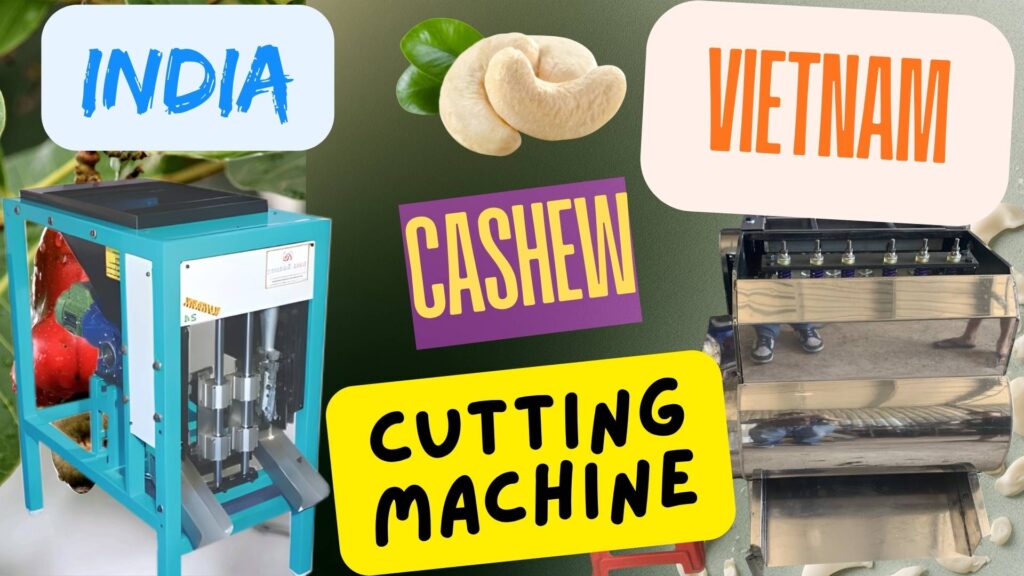
Quick Comparison: Vietnam vs India Cashew Cutting Machine
| Specification | Vietnam (Rotary / Horizontal) | India (Piston / Vertical) |
| Cutting mechanism | Horizontal rotary — continuous cycle | Vertical reciprocating piston |
| Throughput per head | 30–40 kg RCN/hr per head | 15–20 kg RCN/hr per head |
| Motor power (all head counts) | 0.75 kW constant (same across 2–12 heads) | 0.5–1.5 kW — scales with head count |
| Broken kernel rate | Under 3% (standard) | 3–8% (varies by model) |
| Uncut rate | Under 5% | 5–10% |
| CNSL containment | Enclosed head design limits splatter | Open stroke exposes operator and kernel |
| Integration with lines | Standard — links to vibration sieve + separator | Partial — standalone use common |
| Blade material | Carbide-tipped, replaceable | Hardened steel or carbide |
| Throughput at 12 heads | 360–480 kg RCN/hr (single machine) | 180–240 kg RCN/hr (single machine) |
The Fundamental Difference: How Each Machine Cuts
Vietnam Design — Horizontal Rotary Mechanism
A Vietnamese cashew cutting machine uses a horizontal rotary mechanism. Each raw cashew nut is loaded into a cup positioned on a rotating drum. As the drum turns, the cup carries the nut into the blade plane. The blade splits the shell at the equatorial seam — the thinnest point — and the cut nut is discharged. The drum then continues rotating to the next cycle without stopping or reversing direction.
Because the mechanism operates in continuous unidirectional rotation, the motor is always working in the same direction. There is no energy lost to reversing direction, no mechanical stress from direction change, and no cycle time wasted on a return stroke. This is why a single 0.75 kW motor can drive 2, 4, 6, 8, 10, or 12 cutting heads simultaneously — the rotary design is mechanically efficient enough that adding heads multiplies throughput without requiring more motor power.
Indian Design — Vertical Piston Mechanism
An Indian cashew cutting machine uses a vertical reciprocating piston. The nut is placed in a holder beneath the blade. The piston drives the blade downward to split the shell, then the piston must return upward before the next nut can be loaded. Every cut requires two strokes: one down, one up. The motor must accelerate and decelerate on each stroke.
This reciprocating design limits capacity per head to approximately 15–20 kg of RCN per hour. To increase throughput, Indian manufacturers add more heads — but because each piston head requires its own mechanical drive, power consumption scales proportionally with head count. A 10-head Indian machine will typically require a significantly larger motor than a 10-head Vietnamese machine.
Motor Power: The OUTTURN Advantage Explained
| OUTTURN runs the same 0.75 kW (1 HP) three-phase motor across every model — 2-Head through 12-Head. |
This is the single most important technical fact about the OUTTURN range, and it is worth understanding precisely. A 12-head OUTTURN machine processes 360–480 kg of RCN per hour on the same motor that drives a 2-head machine processing 60–80 kg per hour. The motor specification does not change because the rotary mechanism does not require more power to drive more heads — it requires more mechanical geometry, which is a manufacturing decision, not an energy decision.
For a cashew processor, this has a direct financial consequence. Energy cost per kilogram of RCN processed is one of the most controllable operational expenses in a processing plant. A machine that processes twice the volume on the same motor cuts energy cost per tonne by approximately half. Over a full processing season — typically 100–150 operating days — that difference is significant.
Capacity and Power Comparison by Head Count
| Model | OUTTURN (VN) kg/hr | India (typical) kg/hr | OUTTURN Motor | India Motor (est.) | OUTTURN Energy Advantage |
| 2-Head | 60–80 | 30–40 | 0.75 kW | 0.5–1.0 kW | Similar |
| 4-Head | 120–160 | 60–80 | 0.75 kW | 1.0–1.5 kW | 25–50% less |
| 6-Head | 180–240 | 90–120 | 0.75 kW | 1.5–2.2 kW | 50–65% less |
| 8-Head | 240–320 | N/A — rare | 0.75 kW | N/A | No comparison |
| 10-Head | 300–400 | 150–200 | 0.75 kW | 2.2–3.0 kW | 65–75% less |
| 12-Head | 360–480 | 180–240 | 0.75 kW | 3.0–4.0 kW | 75–80% less |
Note: Indian machine throughput and motor figures are industry estimates based on commonly available specifications. Exact figures vary by manufacturer and model. OUTTURN figures are confirmed factory specifications for all OUTTURN machines (CCM.X.OUTTURN.26 series).
CNSL Management: Why the Cutting Mechanism Matters for Safety
Cashew Nut Shell Liquid (CNSL) is a corrosive phenolic compound released when the shell is cut. It can cause severe skin burns on contact and contaminates kernel surfaces if not controlled. The cutting mechanism design directly affects how much CNSL escapes into the working environment and onto the kernel during cutting.
The Vietnamese rotary design encloses the cut within a cup-and-blade assembly. The nut is enclosed in the cup as it enters the blade plane, which limits CNSL splatter to the interior of the cutting head. Periodic cleaning with food-grade oil (coconut oil is standard practice in Vietnamese factories) removes accumulated CNSL from the blade and cup surfaces.
The Indian piston design uses an open downward stroke. The shell is compressed and split from above, which can project CNSL laterally as the shell opens. This requires operators to work further from the machine and makes CNSL contamination of nearby nuts more likely in high-density configurations.
Line Integration: Standalone vs. System Operation
Most cashew processing in Vietnam — where the industry processes over 1 million tonnes of RCN annually — uses cutting machines integrated into complete shelling lines. A standard Vietnamese cutting line connects the cutting machine to a vibration sieve (for scooping and initial shell separation), a centrifugal shell separator, an air blower, and a roller sorter. Bucket conveyors move material between stations.
Vietnamese horizontal rotary cutters are designed with this integration in mind. The discharge geometry of the cutting head is compatible with standard vibration sieves, and the continuous feed mechanism allows consistent flow to downstream equipment. OUTTURN machines can be operated standalone or connected to a vibration sieve and separator to build a partial or complete shelling line.
Indian piston machines are more commonly used as standalone units, particularly in the small-scale Indian processing sector where individual machines serve 2–4 operators in a traditional manual-intensive setup. Integration into automated lines is possible but less standardised.
Which Technology Is Right for Your Operation?
| Choose Vietnam (OUTTURN Rotary) | Consider Indian Design If… |
| Processing 500 kg/day or more | Processing under 200 kg/day with very limited capital |
| 3-phase power is available at your facility | Only single-phase power is available |
| You want to build toward a full cutting line | You want the lowest possible upfront machine cost |
| Energy cost is a significant operational concern | Your RCN supply is small and irregular |
| You are processing RCN from major commercial origins (CdI, Guinea-Bissau, Tanzania, Nigeria, India, Vietnam) | Nearest spare parts source is in India and you have no access to Vietnamese supply chains |
OUTTURN Cashew Cutting Machines — Vietnam Rotary Technology, Factory Direct
OUTTURN designs and manufactures horizontal rotary cashew cutting machines at our factory in Binh Phuoc, Vietnam — the heartland of Vietnam’s cashew processing industry. Every OUTTURN machine uses the same 0.75 kW three-phase motor regardless of head count. The range runs from the 2-Head (60–80 kg/hr) through to the 12-Head (360–480 kg/hr), all built to the same engineering standard, all supplied factory direct with no importers or distributors in the chain.
- 2-Head — CCM.2.OUTTURN.26 — 60–80 kg/hr — from USD 2,000 FOB
- 4-Head — CCM.4.OUTTURN.26 — 120–160 kg/hr — from USD 2,000 FOB
- 6-Head — CCM.6.OUTTURN.26 — 180–240 kg/hr — from USD 2,500 FOB
- 8-Head — CCM.8.OUTTURN.26 — 240–320 kg/hr — from USD 3,000 FOB
- 10-Head — CCM.10.OUTTURN.26 — 300–400 kg/hr — from USD 3,500 FOB
- 12-Head — CCM.12.OUTTURN.26 — 360–480 kg/hr — from USD 4,500 FOB
Contact OUTTURN directly via WhatsApp (+84 979 378 602) or email (cashew.outturn@gmail.com) to discuss your processing capacity, RCN origin, and site power supply. We will recommend the correct model and can supply technical documentation for your procurement decision.


