
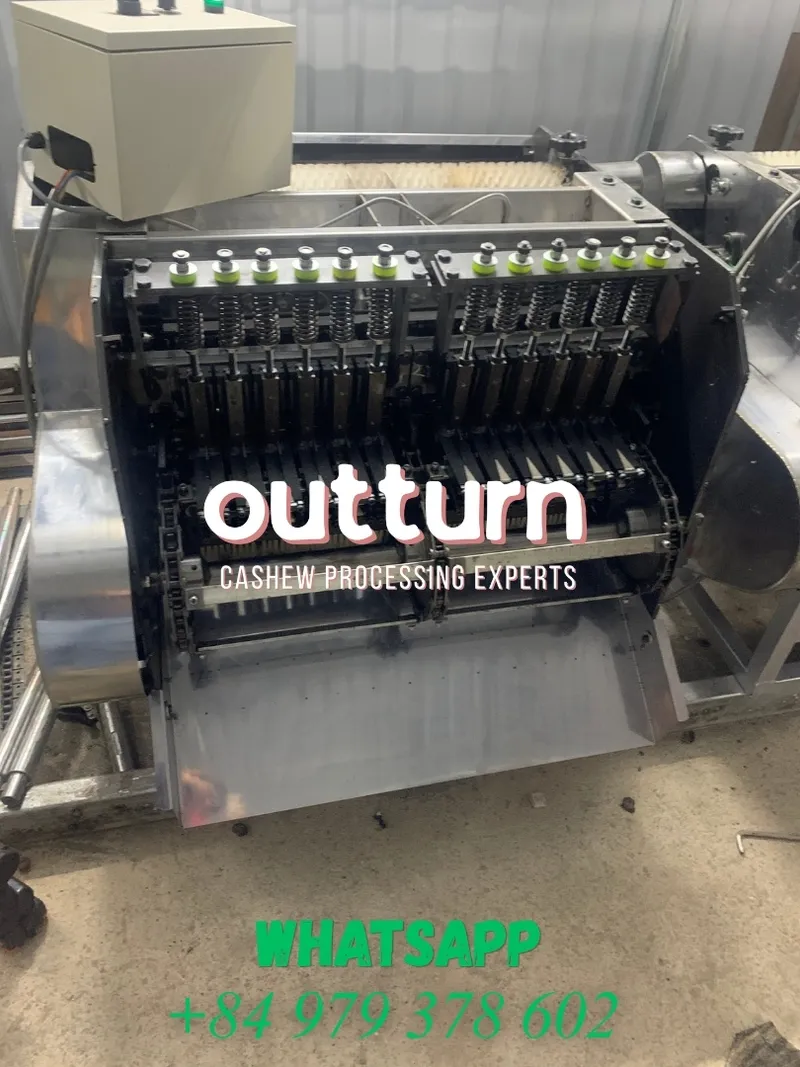
Built for higher-volume cashew lines
The 12-head cashew nut cutting machine is the largest machine in the OUTTURN head-count range, built for processors who have outgrown a single small cutter but aren’t yet ready for a fully automatic line. Twelve individual cup-and-blade cutting stations are arranged around a rotating turret, so instead of one nut at a time from a single station, the machine keeps twelve nuts moving through loading, cutting, and unloading simultaneously. It can be built with all twelve stations on one cup size, or as a dual-size machine with two banks of six.
How the rotary cutting mechanism works
Each cutting station on the turret consists of a cup that holds one steamed raw cashew nut and a blade positioned above it. A single 1.5 kW (2 HP) motor drives the turret through a continuous rotary cycle, carrying each loaded cup into the blade’s cutting plane in sequence. As the rotation carries a cup through the fixed blade, the blade opens the shell along its natural seam, splitting it cleanly without crushing the kernel. The cup then rotates on toward the unloading position while the next cup, already loaded by an operator further back on the turret, moves into place behind it.
Because loading, cutting, and unloading happen at different points around the same rotation rather than as separate stages, operators can work in parallel around the machine — some loading nuts, others clearing cut shells — instead of waiting on a single cutting head to finish one nut before starting the next.
Dual-size configuration: two grades on one machine
The 12-head is available in a dual-size build: instead of twelve stations all fitted for one cup size, the turret is split into two banks of six, each set up for a different RCN size. A machine can be configured with six heads for Size A and six for Size B; another can be ordered with six for Size C and six for Size D — whichever two grades your intake actually runs.
Both banks share one turret, one motor and one frame, so a dual-size machine takes the same floor space, the same power supply and the same maintenance routine as a uniform one. What it removes is the changeover. Processors whose raw material arrives in two distinct size grades normally have to either halt the line and swap cups between batches, or buy a second machine to keep the other grade moving. A 6 + 6 split lets both grades run in the same shift.
The uniform 12-head, with all twelve stations on a single cup size, remains available and is still the better choice if your intake is consistently one grade — all twelve stations stay dedicated to that size, which gives you the machine’s full rated throughput on it. Rated capacity and outturn are the same for both builds; what differs is how the stations are allocated. Tell us the two grades you want to run and we will configure the split before shipping.
How motor power scales across the range
A question we hear often is how motor size changes as head count goes up. Across the OUTTURN range the 2-, 4-, 6- and 8-head machines all run a 1 HP (0.75 kW) motor; the 10-head steps up to 1.5 HP (1.1 kW), and this 12-head to 2 HP (1.5 kW). Power rises in modest steps rather than in proportion to output, because the motor’s job in this design is to turn the turret, carrying each station through the fixed blade in turn — it isn’t powering twelve simultaneous cuts. Going from the 2-head to the 12-head multiplies rated capacity by roughly five and a half times while only doubling motor size, which is what keeps electricity cost per 100 kg of raw nut low even at the top of the range.
Where the 12-head model fits
At 240–280 kg/hr of raw nut input, the 12-head machine sits at the top of our manual-load range — a practical step for processors moving beyond small-batch cutting toward a steadier mid-volume line, without the cost and complexity of a fully automatic system. The shared parts platform across our head-count range also means the cups, blades, and core mechanical components on this machine are the same wear items used on our smaller models, which keeps spares simple to stock if you’re scaling up gradually rather than replacing your whole line at once. Motors are the one item specified per machine rather than shared, since this model uses a 2 HP where the smaller units use 1 HP or 1.5 HP.
As with all OUTTURN cutting machines, actual throughput and kernel outturn depend on nut quality, steaming consistency, and operator technique, so real-world results on your factory floor may vary from the rated figures above. Our team can walk through your current raw material and line setup to help you judge whether the 12-head configuration is the right fit before you order.