 Skip to content
How to Choose the Right Cashew Cutting Machine for Your RCN Grade
The single most common reason a cashew cutting machine underperforms is a mismatch between the machine’s cup and blade geometry and the size of the raw cashew nuts (RCN) being processed. A machine calibrated for large Grade A nuts will undercut small Grade C or D nuts — leaving shells uncut, contaminating kernels with CNSL, and generating broken pieces that reduce your whole kernel yield and export value.
This guide explains how RCN is graded by size, how those grades map to cutting machine specifications, and how to select the correct OUTTURN model and configuration for your RCN supply.
How Raw Cashew Nuts Are Graded by Size
Raw cashew nuts are graded by the diameter of the nut at its widest cross-section, measured in millimetres. The industry uses five standard size grades, though exact nomenclature varies slightly by country and buyer:
| Grade | Diameter (mm) | Count per kg | Common Origins | Processing Note |
| A+ (Jumbo) | ≥ 24 mm | < 160/kg | Brazil, Vietnam (select), India (Goa) | Large cup required; highest WW yield potential |
| A (Large) | 22–24 mm | 160–180/kg | Côte d’Ivoire, Guinea-Bissau, Vietnam | Standard cup — most machines optimised for this grade |
| B (Medium) | 20–22 mm | 180–210/kg | Tanzania, Nigeria, Senegal, Ghana | Standard cup acceptable; check blade gap |
| C (Small) | 18–20 mm | 210–240/kg | Burkina Faso, Benin, Togo, Mali | Smaller cup recommended; increased broken risk with Grade A cup |
| D (Extra Small) | < 18 mm | > 240/kg | Mozambique (late season), Gambia, Guinea | Small cup essential; Grade A machine will miss cuts completely |
Most commercial RCN shipments contain a mix of grades. A typical Côte d’Ivoire shipment might be 60–70% Grade A, 20–25% Grade B, and 5–15% Grade C/D. Guinea-Bissau RCN tends to be slightly smaller on average. Vietnamese RCN is often larger, with significant A+ content.
Why Grade Mismatches Cause Problems
A cutting machine cup is designed to hold a nut of a specific diameter range. When the cup is correctly sized, the nut sits stable as it enters the blade plane — the blade meets the shell at the equatorial seam, where the shell is thinnest, and splits cleanly. When the cup is too large for the nut, the nut moves inside the cup as the drum rotates — the blade may hit the nut off-centre, splitting the kernel rather than the shell, or missing the seam entirely and leaving an uncut nut.
The consequences of grade mismatches compound quickly:
- Uncut nuts (unshelled rate increases) — direct capacity loss, nuts must be re-fed
- Off-centre cuts — broken kernel pieces instead of whole kernels — lower grade, lower price
- CNSL contamination — blade hitting shell body rather than seam releases more CNSL onto kernel surface
- Blade wear acceleration — incorrect contact geometry wears the blade edge faster
- Increased rejects at peeling and grading — downstream quality impact
RCN Grade to OUTTURN Machine Specification
OUTTURN machines are configured at the factory with cup geometry matched to the specified RCN grade. When ordering, specify your RCN origin and the dominant grade in your supply. OUTTURN will confirm the correct cup diameter for your machine.
| RCN Grade | Cup Config | Blade Gap | Expected Broken % | Best OUTTURN Models | Note |
| A+ | Large | Wider | < 2% | 6H, 8H, 10H, 12H | Specify A+ cup at order |
| A | Standard | Standard | < 3% | All models (2H–12H) | Default factory config |
| B | Standard | Standard | < 4% | All models (2H–12H) | Monitor uncut rate in first week |
| C | Small | Narrower | 4–6% | 4H, 6H, 8H | Specify small cup at order |
| D | Extra Small | Narrow | 6–8% | 4H, 6H | Grade D RCN: consider manual cut for odd sizes |
| Mixed (A+B) | Standard | Standard | 3–4% | All models | Size-grade RCN before cutting for best results |
Origin-Specific RCN Size Profiles
Each cashew-producing country has a characteristic RCN size distribution. Knowing your origin helps predict the correct cup specification before your RCN arrives:
| Origin | Dominant Grade | Size Distribution | Recommended Cup |
| Côte d’Ivoire | A (large) | ~65% A, ~25% B, ~10% C/D | Standard (Grade A default) |
| Guinea-Bissau | A–B | ~40% A, ~40% B, ~20% C | Standard — monitor B/C split |
| Tanzania | B (medium) | ~30% A, ~50% B, ~20% C | Standard or small depending on season |
| Nigeria | B | ~35% A, ~45% B, ~20% C/D | Standard |
| Burkina Faso | C–B | ~20% A, ~40% B, ~40% C | Small cup recommended |
| Vietnam | A–A+ | ~30% A+, ~50% A, ~20% B | Standard or large depending on lot |
| India (Kerala) | B–C | ~20% A, ~45% B, ~35% C/D | Small cup for best results |
| Brazil | A+ | ~40% A+, ~40% A, ~20% B | Large cup |
Important: size distributions vary seasonally and by growing region within each country. Early-season RCN tends to be smaller; late-season nuts are typically larger. Always check the KOR and size profile of the specific parcel before setting machine configuration.
Should You Size-Grade RCN Before Cutting?
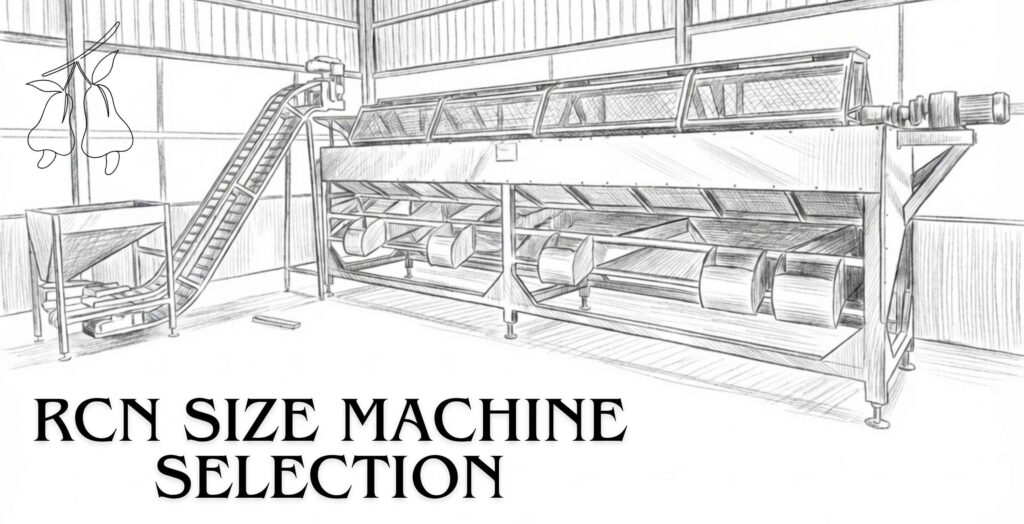
In a fully optimised processing plant, RCN is calibrated (size-graded) before steaming and cutting. A drum calibrator separates RCN into A, B, C, and D grade streams which are then processed through machines configured for each grade. This approach maximises whole kernel yield across all grades by ensuring each nut enters a correctly-sized cup.
For smaller operations (under 2 TPD), size-grading before cutting may not be practical. In this case, the recommendation is to configure the machine for the dominant grade in your RCN supply and accept slightly higher broken rates on the off-grade nuts. A 6-Head or 8-Head OUTTURN machine configured for Grade A with a typical Grade B/C mix from Tanzania or Nigeria will achieve approximately 3–5% broken rate — acceptable for most market grades.
For operations above 2 TPD, investing in a drum calibrator before the cutting station significantly improves WW (whole white) kernel yield and reduces the volume of broken and split kernels going to lower-value grades. Contact OUTTURN to discuss calibrator integration with your cutting line.
Multi-Grade Operations: Running Two Grades Simultaneously
Some processors run two machines simultaneously — one configured for Grade A, one for Grade B/C — and split their RCN stream by grade before feeding. This is the most common configuration in Vietnamese factories processing mixed-origin RCN from West Africa.
A typical 2 TPD plant might run:
- One 8-Head or 10-Head OUTTURN configured for Grade A — processing the large nut stream
- One 6-Head OUTTURN configured for Grade B/C — processing the medium and small nut stream
This dual-machine configuration requires a calibrator to split the stream, but achieves significantly higher whole kernel yield than running all grades through a single machine on one configuration.
OUTTURN Range — Choose Your Model by Capacity
| All OUTTURN machines run on 0.75 kW (1 HP) three-phase motor — factory direct from Binh Phuoc, Vietnam |
| Model | SKU | Throughput | Plant Scale | Price FOB | Grades Supported |
| 2-Head | CCM.2.OUTTURN.26 | 60–80 kg/hr | 400–600 kg/day | From USD 2,000 | A, B (specify) |
| 4-Head | CCM.4.OUTTURN.26 | 120–160 kg/hr | 800 kg–1.2 TPD | From USD 2,000 | A, B, C (specify) |
| 6-Head | CCM.6.OUTTURN.26 | 180–240 kg/hr | 1–1.5 TPD | From USD 2,500 | A, B, C, D (specify) |
| 8-Head | CCM.8.OUTTURN.26 | 240–320 kg/hr | 1.5–2.5 TPD | From USD 3,000 | A, B, C (specify) |
| 10-Head | CCM.10.OUTTURN.26 | 300–400 kg/hr | 2–3 TPD | From USD 3,500 | A, B (primary) |
| 12-Head | CCM.12.OUTTURN.26 | 360–480 kg/hr | 3–4 TPD | From USD 4,500 | A, B (primary) |
When contacting OUTTURN to order, always provide: (1) your RCN origin country; (2) the grade distribution if known; (3) your daily processing target in TPD; (4) whether you are running standalone or integrating with a vibration sieve system. This allows OUTTURN to confirm the correct cup configuration for your machine before manufacture.


