
Automatic Cashew Nut Cutting Machine
Complete Cutting Lines: Multiple Cutters · Vibration Sieve · Centrifuge · Blower · Automatic Scooping & De-Shelling
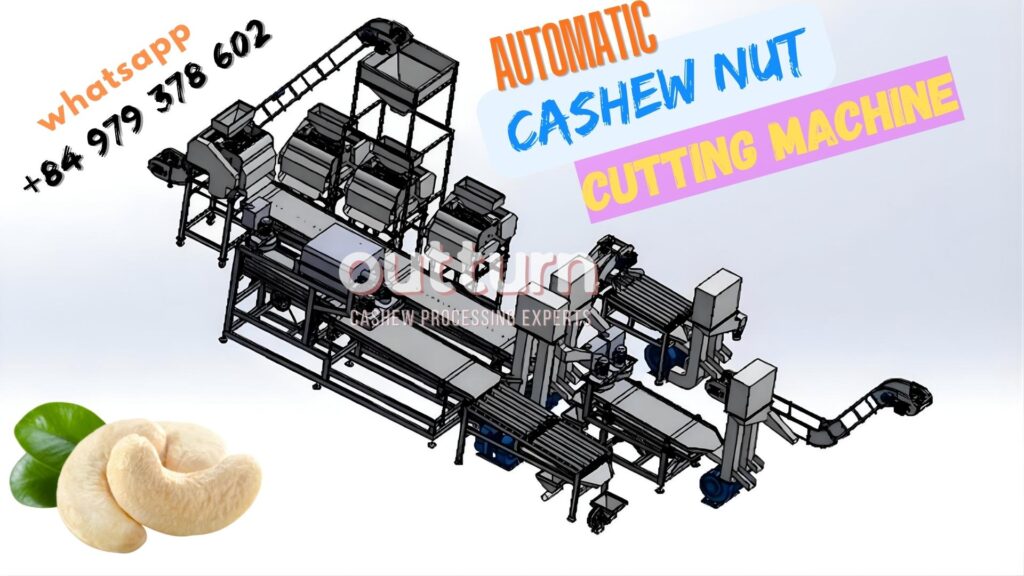
An automatic cashew nut cutting machine integrates multiple cutting heads with a vibration sieve, centrifuge, air blower, and roller separator into a single fully automated line — cutting raw cashew nuts, separating kernels from shells, routing uncut and unscooped nuts back for reprocessing, and delivering clean kernels to the next stage with minimal labour. OUTTURN designs and manufactures complete automatic cutting lines from its factory in Binh Phuoc, Vietnam.
What Is an Automatic Cashew Nut Cutting Machine?
A standalone cashew cutter does one job: it cuts the shell of a raw cashew nut. A single operator feeds nuts, the machine splits shells, and the output — a mixed stream of open shells, kernels, uncut nuts, and shell fragments — falls into a bin for manual sorting. This is how most small operations work.
An automatic cashew nut cutting machine is something fundamentally different. It is a complete integrated processing line in which the cutter is just the first stage. Everything that comes out of the cutter — kernels, shells, uncut nuts, half-cut nuts, shell fragments — is handled automatically by the downstream equipment: vibration sieve, centrifuge, air blower, roller separator, and bucket elevator. No manual sorting between cutting and the tray dryer. The entire sequence from raw nut input to clean kernel output runs from a single control panel with two workers per shift, regardless of whether the line processes 300 kg/hr or 1,500 kg/hr.
Vietnam vs India pattern: In Vietnam, standalone cutters are virtually unused in commercial processing — every cutter operates as part of an integrated automatic line. In India, the industry has historically relied on manual scooping and sorting between stages, but is now rapidly converting to integrated automatic lines, many sourced directly from Vietnam manufacturers including OUTTURN.
Why the Terminology Differs: Cutting vs Shelling vs Scooping
The cashew industry uses overlapping terminology, especially between Indian and Vietnamese processing traditions. Understanding the terms is essential for buying the right equipment and specifying the right line:
| Term | What It Means | Where Used |
| Cutting | The act of splitting the shell with a blade to expose the kernel — the primary mechanical action | Vietnam, Africa, international trade |
| Shelling / Deshelling | Separating kernel from shell after the cut — the complete extraction result | India, international |
| Scooping | The Indian industry term for the same process — extracting (scooping out) the kernel from the opened shell. The scooping machine automates what was done manually with a small curved blade. | India primarily — now standard across Africa |
| Unscooped nuts | Nuts where the shell was cut but the kernel did not separate cleanly and remains partially or fully embedded in the shell halves | Universal — all processing lines produce some |
| Uncut nuts | Nuts that passed through the cutter without the blade making contact — blade gap too wide or nut too small for the calibration. The shell is intact and the kernel is untouched. | Universal — quantity depends on calibration quality |
OUTTURN design principle: Every OUTTURN automatic line handles all four output streams — whole kernels, shells, unscooped nuts, and uncut nuts — without manual intervention. Nothing leaves the machine requiring hand-sorting before it reaches the tray dryer or the recirculation loop.
Components of an Automatic Cashew Cutting Line
A complete OUTTURN automatic cutting line consists of the following components, each performing a specific function in the material flow sequence. The configuration — number of cutters, number of sieve decks — is scaled to the target throughput.
1. RCN Infeed Tank and Feed Conveyor
The infeed tank is a hopper that holds steamed and rested raw cashew nuts ready for cutting. The tank feeds nuts continuously onto the conveyor that distributes them to the cutting heads. The feed rate is controlled to match the combined cutting capacity of the machines in the line, preventing starvation (cutters running empty) or overfeeding (nuts piling up at the blade).
- Capacity: typically 100–300 kg holding volume depending on line size
- Feed mechanism: gravity-fed with adjustable gate or motorised conveyor belt
- Material: food-grade stainless steel throughout
- Control: integrated with the main line control panel — feed rate adjustable without stopping the line
Steaming prerequisite: Nuts must be steamed for 10–15 minutes and rested for 15–18 hours before entering the infeed tank. Steaming softens the shell; resting makes it brittle. Both conditions must be correct before cutting. An OUTTURN line cannot compensate for under-steamed or improperly rested nuts — correct pre-treatment is the foundation of high WKR.
2. Cutting Heads — Multiple Machines in One Line
The cutting heads are the core of the line. In an automatic line, multiple OUTTURN cutting machines work in parallel, fed from the same infeed system and discharging into the same downstream sieve. This is fundamentally different from operating standalone machines in separate positions — in a line configuration, the cutters are synchronised, balanced, and integrated.
How Multiple Cutters Are Configured in a Single Line
The standard Vietnam automatic line configuration uses 4 cutting machines per line. This number is not arbitrary — it reflects the balance between cutter throughput, sieve capacity, and manageability from a single control panel. The most common configurations are:
| Line Config | Cutters per Line | Heads per Cutter | Sieve Type | Throughput (RCN Input) |
| Entry / Small | 1 | 8 or 10 head | Single sieve | 250–350 kg/hr |
| Standard | 2–3 | 8 or 10 head | Single sieve | 500–1,000 kg/hr |
| Medium | 4 | 8 or 10 head | Double sieve | 1,000–1,200 kg/hr |
| Large | 4 | 10 or 12 head | Triple sieve | 1,200–1,500 kg/hr |
| High-Volume | Multiple lines | 10–12 head | Triple sieve per line | 2,000–4,000+ kg/hr |
Each cutting machine in the line processes one nut size grade. Because RCN is size-sorted before the cutting stage, Grade A nuts go to machines calibrated for A-grade, Grade B nuts to B-grade machines, and so on. The automatic line respects the same per-grade isolation principle as standalone machines — it simply automates the downstream separation of what comes out.
Why 4 Cutters Is the Standard Configuration
Four cutting machines per sieve line has become the Vietnamese industry standard for practical reasons. A single 10-head OUTTURN machine cuts approximately 250–300 kg/hr. Four machines together produce 1,000–1,200 kg/hr, which matches the rated throughput of a double-deck vibration sieve — the most efficient sieve configuration for kernel separation. Fewer cutters under-utilise the sieve; more cutters overwhelm it and compromise separation quality.
OUTTURN line design: Contact OUTTURN with your daily RCN volume and shift hours. We calculate the correct number of machines per line, the appropriate sieve configuration, and the optimal grade distribution across machines for your specific origin mix. Factory-direct from Binh Phuoc, Vietnam.
3. Vibration Sieve — Automatic Kernel and Shell Separation
The vibration sieve is the separation workhorse of the automatic line. All output from the cutting machines — kernels, shell halves, shell fragments, uncut nuts, unscooped nuts, and CNSL-contaminated debris — falls onto the vibration sieve where the first-stage separation occurs.
How the Vibration Sieve Works
The sieve is a flat or slightly inclined perforated deck that oscillates at high frequency. The mesh aperture is sized so that cashew kernels and small shell fragments fall through the deck, while whole shell halves, unscooped nuts, and uncut nuts ride over the top and are discharged to the roller separator. The vibration keeps material moving continuously — no manual raking or turning.
- Deck material: perforated stainless steel or tensioned wire mesh — food-grade throughout
- Mesh aperture: sized for the specific nut origin and grade being processed
- Vibration frequency: adjustable to control residence time and separation efficiency
- Output below deck: kernels + small shell fragments — proceed to centrifuge and blower
- Output over deck: shell halves, unscooped nuts, uncut nuts — proceed to roller separator
Single, Double, and Triple Deck Sieves — What the Difference Means
The number of sieve decks directly determines separation efficiency and the cleanliness of the kernel stream. Each additional deck handles a separation stage that would otherwise require manual intervention:
| Sieve Type | What It Separates | Best For | Cutters Supported |
| Single deck | First-pass kernel / shell separation. Simple. Some large shell pieces may pass through with kernels. | Entry-level lines, small factories, budget-conscious setup | 1–3 cutters |
| Double deck | First deck: large shell halves over, kernels + fine debris through. Second deck: further size classification of the kernel stream, removing fine shell dust. | Standard commercial lines, most African and Asian processors | 3–4 cutters |
| Triple deck | Three-stage separation: coarse shells, medium debris, fine dust — each handled separately. Cleanest kernel output of all configurations. | High-volume export-grade facilities, when tray dryer input quality is critical | 4+ cutters |
The general industry principle: more sieve decks mean less post-sieve manual cleaning of the kernel stream. A triple-deck sieve with 4 cutters produces kernel output that requires minimal additional sorting before drying — significantly reducing the labour required downstream.
CNSL contamination risk: The shell of a raw cashew nut contains CNSL (Cashew Nut Shell Liquid) — a powerful irritant that causes severe skin burns. When the shell is cut, CNSL is released. If shell fragments remain mixed with kernels beyond the sieve stage, CNSL can contaminate the kernel surface and compromise food safety. The vibration sieve must separate shell from kernel quickly and completely. This is why CNSL-resistant stainless steel construction and rapid shell extraction are non-negotiable design requirements.
4. Centrifuge — CNSL Removal and Fine Shell Separation
After the vibration sieve, the kernel stream still carries residual CNSL oil from cut shell surfaces and fine shell fragments too small to be caught by the sieve mesh. The centrifuge addresses both problems simultaneously.
How the Cashew Centrifuge Works
The cashew centrifuge is a horizontal drum with a perforated basket that rotates at 1,200–1,500 RPM. The kernel stream enters the drum and is spun at high speed. CNSL oil and fine wet shell particles are flung outward through the perforations by centrifugal force, leaving behind dryer, cleaner kernels. The discharged liquid is collected as CNSL — a commercially valuable by-product used in polymer and resin manufacturing.
- Rotation speed: 1,200–1,500 RPM — standard for cashew kernel processing
- CNSL recovery: the centrifuge is the primary CNSL extraction point in an automatic line
- Kernel benefit: kernels exit the centrifuge with reduced surface CNSL, lower moisture on the shell surface, and fewer fine shell fragments mixed in
- Throughput: one centrifuge unit typically handles the output of 2–4 cutting machines
- Material: full stainless steel — CNSL is highly corrosive to mild steel
CNSL commercial value: Cashew Nut Shell Liquid collected from the centrifuge is not waste — it is sold to chemical processors who use it to produce cardanol, phenol resins, brake linings, and anti-corrosion coatings. A factory processing 1,000 kg/hr of RCN can recover 40–60 litres of CNSL per hour from the centrifuge stage alone. This is a recoverable revenue stream that partially offsets processing costs.
5. Air Blower (Pneumatic Aspirator) — Shell Discharge
After the centrifuge, the material still contains a mixture of kernels and shell pieces that are similar in size but different in weight. The air blower exploits this weight difference to separate them using airflow — the same principle as grain winnowing, applied with industrial precision.
How the Blower Separation Works
The kernel-shell mixture is dropped or conveyed through a controlled airstream. Shell pieces — which are hollow, lightweight, and have a large surface area relative to their weight — are lifted by the air and carried into a shell collection duct. Dense, compact kernels are too heavy to be lifted and fall through to the kernel collection tray. The air velocity is calibrated to the specific weight difference between the kernels and shells being processed — too fast lifts kernels too; too slow leaves shells in the kernel stream.
- Shell removal efficiency: 95–98% of empty shell pieces removed in a single pass
- Air velocity: adjustable; must be recalibrated when changing nut origin or grade
- Shell output: collected pneumatically and conveyed to shell storage — used as boiler fuel
- Kernel output: falls to final collection tray or conveyor to tray dryer infeed
- Dust: fine CNSL-contaminated dust is captured in a secondary dust collector, not released into the factory air
Half-Cashew Fan — Separate Blower for Split Kernels
Advanced automatic lines include a secondary blower specifically tuned for half-kernel and split kernel separation. Because split kernels have a different aerodynamic profile to whole kernels, a separate fan with different air velocity settings can separate them from the whole kernel stream without manual inspection. This allows the line to produce two kernel streams — whole kernels and splits — simultaneously, each going to separate trays for drying and grading.
6. Roller Separator — Uncut and Unscooped Nut Handling
The roller separator is the most operationally important component that most non-Vietnam processors are unfamiliar with. It handles the two problem outputs that every cutting line produces regardless of calibration quality: uncut nuts and unscooped nuts.
Understanding Uncut Nuts vs Unscooped Nuts
| Output Type | What It Is | Root Cause |
| Uncut nuts | The shell is completely intact. The blade made no contact. The kernel is fully enclosed — untouched by the cutting process. | Blade gap too wide for nut size; nut misaligned in cutting cup; D-grade nut too small for current calibration |
| Unscooped nuts (half-cut) | The shell has been cut but the two halves are not fully separated. The kernel is partially or fully exposed but remains attached to one or both shell halves.’, 3680) | Insufficient shell opening force; shell too thick; steaming time too short; small variation in nut size within grade |
| Un-scooped kernels | The shell halves have separated but the kernel is still physically stuck to the inner shell surface by the testa (inner skin). The kernel needs to be physically extracted. | Kernel is concave and wraps around shell interior contours; under-steaming causes adhesion; a normal occurrence even in well-calibrated lines |
How the Roller Separator Works
The output that rides over the vibration sieve top deck — which contains shell halves, unscooped nuts, and uncut nuts — is fed onto the roller separator. The separator consists of a series of parallel cylindrical rollers with a specific gap between them. Shell halves — which are curved, thin, and hollow — fall between the rollers or are oriented by the roll pattern to fall through. Uncut nuts and unscooped nuts — which are round and solid — roll along the top of the rollers and are discharged at the far end.
- Shell halves: fall between rollers, discharged to shell collection conveyor
- Uncut nuts: roll over rollers, discharged to bucket elevator for return to cutter infeed
- Unscooped nuts: separated from shells, discharged to mechanical scooper or manual scooping table
Recirculation of Uncut Nuts
Uncut nuts discharged from the roller separator are not discarded — they are returned to the cutting machine via a bucket elevator for a second cutting pass. This recirculation loop is fully automatic in a properly configured OUTTURN line. The bucket elevator lifts the uncut nuts back to the infeed tank level, where they join the main cutting feed. A well-calibrated line achieves a recirculation rate of 5–8% — meaning 5–8% of nuts require a second pass. A poorly calibrated line can reach 15–20% recirculation, indicating a blade gap or size sorting problem that needs correction.
Key metric: Monitor your recirculation rate. If the bucket elevator is visibly full and working hard, your uncut rate is high. The cause is almost always a blade gap calibrated for the wrong grade, or size-sorted nuts that were not separated finely enough before the cutting stage.
7. The Scooping Machine — Automatic Kernel Extraction
Scooping is the Indian industry’s term for the process of physically extracting (scooping out) the cashew kernel from the opened shell halves. In manual processing, a worker uses a small curved metal blade to pry the kernel free from the shell. In an automatic line, the scooping machine replaces this entirely.
What the Scooping Machine Does
The unscooped nuts discharged from the roller separator — those where the shell cut but the kernel did not separate — are fed into the scooping machine. The machine applies a combination of mechanical pressure, oscillation, and impact to free the kernel from its shell adhesion without breaking it. The scooped kernel and the now-empty shell halves are then separated by a secondary sieve and blower within the scooping machine assembly.
- Input: unscooped nuts — shell cut, kernel still adhering
- Mechanism: oscillation, vibration, and controlled mechanical impact to release kernel adhesion
- Output stream 1: freed kernels — passed to secondary sieve and blower for shell removal
- Output stream 2: empty shell halves — conveyed to shell collection
- Output stream 3: any remaining unscooped kernels — returned to manual scooping table
Primary and Secondary Scooping Stages
In high-throughput automatic lines, scooping is divided into two stages to maximise kernel recovery without breakage:
- Primary separator — first-pass separation of kernels from the bulk of the shell output. Handles the majority of the unscooped stream.
- Primary shell blower — air separation to remove empty shell halves from the kernel output of the primary separator.
- Bucket elevator — lifts remaining unscooped material to the secondary scooping stage.
- Secondary scooping machine — applies additional mechanical force to release kernels that the primary stage did not free.
- Secondary separator and blower — final shell removal from the secondary scooped kernel stream.
- Roller-based uncut/unscooped separator — final classification of any remaining uncut nuts, routing them back to the main recirculation loop.
After the full scooping sequence, any kernels that are still embedded despite two mechanical passes are sent to the manual scooping table — a small workstation at the end of the line where workers handle only the residual cases that automation could not address. In a well-configured OUTTURN line, this table handles less than 3% of the total kernel volume.
8. Bucket Elevator — The Line’s Vertical Transport System
The bucket elevator is the conveying backbone of the automatic line. It transfers material between stages that are at different heights — specifically, returning uncut nuts from the roller separator (at floor level) back up to the infeed tank (at elevated level), and transferring unscooped nuts between the primary and secondary scooping stages.
- Construction: stainless steel buckets on a continuous belt or chain
- Capacity: sized to handle the full recirculation volume of the line
- CNSL resistance: all contact surfaces food-grade SS 304 — essential given CNSL contact
- Speed: variable to match recirculation rate; controlled from the main panel
- Number of units: a standard 4-cutter line typically uses 2 bucket elevators
9. Central Control Panel — Single-Point Line Management
All operations of the automatic cutting line — cutter speed, sieve vibration frequency, centrifuge RPM, blower air velocity, bucket elevator speed, and infeed rate — are controlled from a single control panel. This is what makes the line truly automatic from an operational standpoint.
- Panel type: PLC (Programmable Logic Controller) with display panel
- Operators required: 2 workers per shift for a 4-cutter, triple-sieve line
- Emergency stop: single button stops all line components simultaneously
- Motor protection: overload protection on all drive motors
- Monitoring: visual indicators for each component’s operational status
Labour reduction benchmark: A manual cutting and scooping operation handling 1,000 kg/hr of RCN input requires 40–60 workers across cutting, sorting, and scooping stations. The equivalent OUTTURN automatic line requires 2 operators. The capital investment in the automatic line typically achieves payback within 12–18 months in a West African factory context.
Complete Material Flow — From Raw Nut to Clean Kernel
Understanding the complete material flow is essential for factory layout planning, capacity sizing, and troubleshooting. The following sequence traces every output stream from RCN infeed to tray dryer input:
STEP 1 RCN Infeed — Steamed and rested raw cashew nuts (sorted by grade) loaded into the infeed tank. Feed rate set to match cutter capacity.
STEP 2 Cutting — Nuts distributed across 4 cutting machines (or configured number). Each machine splits the shell along its natural seam. Output: open-shell nuts, uncut nuts, shell fragments, liberated kernels.
STEP 3 Vibration Sieve — First Separation — All cutter output onto the vibration sieve. Through deck: kernels + fine debris. Over deck: shell halves + unscooped nuts + uncut nuts.
STEP 4 Centrifuge — Kernel stream (from under the sieve) spun at 1,200+ RPM. CNSL oil and fine shell particles expelled. Output: cleaner, drier kernels. CNSL collected as by-product.
STEP 5 Air Blower — Shell Winnowing — Centrifuged kernel stream passed through calibrated airstream. Lightweight empty shell pieces lifted and removed. Heavy kernels fall through. Shell fragments pneumatically conveyed to shell storage.
STEP 6 Roller Separator — Uncut / Unscooped Classification — Over-sieve material (shells + unscooped + uncut) passes over roller array. Shell halves fall between rollers. Solid nuts (uncut + unscooped) roll over top and discharge separately.
STEP 7 Recirculation Loop — Uncut Nuts — Uncut nuts lifted by bucket elevator back to infeed tank for second cutting pass. Monitored continuously — high recirculation rate signals calibration issue.
STEP 8 Primary Scooping — Unscooped nuts (shell cut, kernel adhering) fed to scooping machine. Oscillation and mechanical action frees kernel from shell adhesion. Most kernels liberated here.
STEP 9 Secondary Sieve + Blower — Post-Scooping Separation — Scooped kernel stream separated from empty shells by sieve and secondary blower. Shells to shell storage. Kernels join main kernel stream.
STEP 10 Secondary Scooping Stage — Remaining unscooped material (bucket elevator from primary stage) processed through secondary scooper and separator for maximum kernel recovery.
STEP 11 Manual Scooping Table — Any kernels still embedded after two mechanical scooping passes sent to manual table. Target: less than 3% of total kernel volume. Workers at this table are the only manual intervention in the process.
STEP 12 Clean Kernel Output — Tray Dryer Infeed — Combined kernel streams from blower, centrifuge, and scooping stages collected at the tray dryer infeed. Kernels enter the dryer as a clean, shell-free stream ready for testa drying.
OUTTURN Cutting Machines — Configured for Automatic Lines
Every OUTTURN cutting machine is designed to operate both as a standalone unit and as a component in an automatic cutting line. The same machine that a small processor uses as a single standalone cutter is the same machine that a large factory integrates into a 4-cutter automatic line. There is no separate ‘automatic line machine’ — the integration hardware (infeed conveyor connection, discharge chute to sieve) is configured at installation.
| Model | Heads | Throughput/hr | Power | SKU | Best Line Role |
| 2-Head | 2 | 60–100 kg | 0.75 kW | CCM.2.OUTTURN.26 | D-grade dedicated stream in large lines; entry-level standalone |
| 4-Head | 4 | 120–200 kg | 0.75 kW | CCM.4.OUTTURN.26 | A-grade or A+ stream; standalone single-cutter line |
| 6-Head | 6 | 150–250 kg | 0.75 kW | CCM.6.OUTTURN.26 | B-grade stream; 2-cutter lines |
| 8-Head | 8 | 200–280 kg | 0.75 kW | CCM.8.OUTTURN.26 | Standard 4-cutter line component; most common |
| 10-Head | 10 | 250–300 kg | 0.75 kW | CCM.10.OUTTURN.26 | 4-cutter line at 1,000–1,200 kg/hr total; high-volume lines |
| 12-Head | 12 | 300–350 kg | 0.75 kW | CCM.12.OUTTURN.26 | Maximum throughput per machine; large 4-cutter lines up to 1,400 kg/hr |
All models: horizontal rotary cutting mechanism, 3-phase motor, CNSL-resistant stainless steel construction, adjustable blade gap, standard blade change under 5 minutes, price range USD $2,000–$5,000 FOB Vietnam.
Power advantage: Every OUTTURN cutting machine uses exactly 0.75 kW (1 HP) regardless of head count — from 2-head to 12-head. A 4-machine automatic line uses just 3 kW total for all cutters. The vibration sieve, centrifuge, blower, and bucket elevators add approximately 4–6 kW. Total automatic line power consumption: 7–9 kW for a 1,000 kg/hr line. This makes OUTTURN lines highly compatible with solar power and generator supply in remote African processing locations.
Choosing the Right Automatic Line Configuration
The right configuration depends on four factors: daily RCN volume, shift hours, origin (which determines D-grade fraction and size profile), and budget. The following guide covers the most common scenarios:
For 500–800 kg/hr Target Throughput
- Configuration: 2–3 OUTTURN 8-head or 10-head machines + single or double sieve + 1 centrifuge + 1 blower
- Workers: 2 per shift
- Suitable for: medium factories, 1–2 shift operations, mixed West African origins
- Daily output (2 shifts): approximately 4–6 tonnes RCN processed
For 1,000–1,200 kg/hr Target Throughput — The Standard Line
- Configuration: 4 x OUTTURN 8-head or 10-head machines + double sieve + 2 centrifuges + 2 blowers + 2 bucket elevators + roller separator + scooping machine
- Workers: 2 per shift
- Suitable for: commercial-scale processing, 2-shift operations, any African or Asian origin
- Daily output (2 shifts): 8–10 tonnes RCN processed
- This is the reference configuration for most OUTTURN complete line orders
For 1,200–1,500 kg/hr Target Throughput
- Configuration: 4 x OUTTURN 12-head machines + triple sieve + 2–3 centrifuges + blowers + full recirculation loop
- Workers: 2–3 per shift
- Suitable for: large commercial processors, 3-shift operations, high-volume export factories
- Daily output (3 shifts): 15–18 tonnes RCN processed
Multi-Line Scaling
Factories processing above 2,000 kg/hr typically operate multiple parallel lines rather than a single large line. Two 1,000 kg/hr lines are preferable to one 2,000 kg/hr line because they offer redundancy — if one line is down for maintenance, the factory continues at 50% rather than 0% output. OUTTURN supplies complete multi-line factories with a single factory-direct contract from Binh Phuoc.
Whole Kernel Recovery in Automatic Lines vs Standalone Cutters
A common question from processors upgrading from standalone to automatic: does the automatic line improve WKR, or does it just reduce labour? The answer is both — but they work through different mechanisms.
| WKR Factor | Standalone Cutter | Automatic Line (OUTTURN) |
| Kernel handling after cutting | Manual scooping — frequent kernel contact, variable technique, breakage from rough handling | Automated — centrifuge and blower handle kernels with no manual contact until tray dryer |
| Shell contamination of kernels | Manual sorting misses fine shell fragments; CNSL contamination from shell contact | Centrifuge + blower removes shell and CNSL residue systematically |
| Uncut nut handling | Manual re-feed — delayed, inconsistent, often skipped when production pressure is high | Automatic recirculation — every uncut nut returns to the cutter immediately and consistently |
| Unscooped nut recovery | Depends entirely on worker skill and attention — highly variable | Mechanical scooping with two stages recovers the vast majority automatically |
| Typical WKR achieved | 62–70% depending on worker skill and origin | 72–77% on same origin — automatic handling eliminates most breakage sources |
The 5–10% WKR improvement from automatic to manual is primarily driven by three factors: elimination of rough manual kernel handling, systematic recirculation of every uncut nut (not just those workers remember to re-feed), and complete CNSL removal by the centrifuge. The financial impact is significant.
Financial illustration: A factory processing 5,000 kg/hr RCN at 22% kernel recovery achieving 72% WKR vs 65% WKR: the automatic line produces an extra 0.07 × 0.22 × 5,000 = 77 kg of whole kernel per hour. At $3.50/kg kernel and 16 operating hours/day, that is $4,312 additional revenue per day — or over USD $1 million per year from the WKR improvement alone, before counting the labour saving.
Frequently Asked Questions – Automatic Cashew Nut Cutting Machine
Get a Complete Line Specification — Factory Direct from Vietnam
OUTTURN designs and manufactures complete automatic cashew cutting lines from our factory in Binh Phuoc, Vietnam — the heart of the world’s cashew processing industry. Every line is built to your daily volume, origin mix, and shift configuration. We supply:
- Complete automatic lines — all components, single factory-direct contract
- Individual OUTTURN cutting machines — 2-head through 12-head, USD $2,000–$5,000 FOB Vietnam
- Spare parts — all blade configurations, bearings, belts, available from stock
- Technical support — line design consultation, installation guidance, calibration advice

