
Cashew Cutting Machine: 2-Head, 4-Head, 6-Head, 8-Head, 10-Head and 12-Head — Which One Fits Your Plant
The head count on a cashew cutting machine spec sheet — 2, 4, 6, 8, 10, 12 — is the primary sizing parameter. It tells you how many nuts are being cut simultaneously, which determines throughput. But it does not change the motor. On OUTTURN machines, all models from 2-head to 12-head run the same 1 HP / 0.75 kW three-phase motor. More heads means more cutting positions, not a bigger engine.
That single fact drives most of the sizing logic in this article. The rest covers how the mechanism works, what separates Vietnamese rotary design from Indian piston design, what blade life looks like by RCN origin, and the full cost of ownership beyond the FOB price.
All OUTTURN throughput and power figures here are from factory-verified data. Competitor figures (Konark series) are sourced from Sairaj Machinery Pvt. Ltd published datasheets.
QUICK SIZING REFERENCE Up to 1 tonne RCN/day: 4-head. 1–3 tonnes/day: 8-head. 3–5 tonnes/day: 10-head or 12-head. Beyond 5 tonnes/day: multiple machines. KOR assumed at 23% to convert kernel targets to RCN volumes.
The Cutting Mechanism
A cashew cutting machine splits the outer shell of a steamed raw cashew nut (RCN) to release the kernel without breaking it. The mechanical challenge is that the cashew kernel sits inside an asymmetric, double-curved shell — split in the wrong plane and you cut the kernel directly.
The Vietnamese rotary design addresses this with horizontal rotating heads. Each head carries two opposing blades. Steamed nuts feed into the rotating assembly, and the blades score and split the shell along its natural seam — the longer axis of the nut. Because the nut’s own geometry guides where the blades meet the shell, orientation happens largely through the feed geometry rather than by operator positioning of individual nuts.
The Indian vertical piston design, used in machines like the Konark series by Sairaj Machinery Pvt. Ltd, takes a different approach. Nuts are fed vertically into a piston mechanism that drives two blades down from above. The operator — or a mechanical guide — controls nut orientation before the blade stroke. This produces higher whole kernel rates on calibrated nut sizes but is slower than the rotary mechanism at high throughput.
Both mechanisms work. Which one is appropriate for a given plant depends on throughput requirement, RCN origin, and whether the priority is whole kernel rate or volume. More on that in the design comparison section below.
⚑ UPSTREAM PROBLEM, DOWNSTREAM BLAME: An understeamed nut has a kernel that fractures on contact with the blades — not because the machine is miscalibrated, but because the kernel is still too brittle. An oversteamed nut produces a wet, sticky kernel that jams the feed and tears during shell separation. Poor whole kernel rates are blamed on the cutting machine more often than they should be. Steaming time of 15–25 minutes at 2–4 bar gauge pressure, followed by 8–12 hours of rest before cutting, is the standard operating procedure for W240–W320 RCN from West or East Africa. Harder-shell origins run 35–45 minutes. The steaming guide on this site covers origin-specific parameters.
OUTTURN Model Specifications
All OUTTURN single-unit machines share the same motor — 1 HP / 0.75 kW, three-phase — regardless of head count. The table reflects mid-range throughput under standard operating conditions: correctly steamed W240–W320 RCN, stable power supply, experienced operators.
| Model | Heads | Throughput (kg/hr) | Motor | Whole Kernel Rate | Operators | Capacity Tier |
| 2-Head | 2 | 35–50 | 1 HP / 0.75 kW, 3-phase | ~85% | 1 | Micro-plant, trial run, backup unit |
| 4-Head | 4 | 80–100 | 1 HP / 0.75 kW, 3-phase | ~85–88% | 1 | Small plant: 500 kg–1 tonne RCN/day |
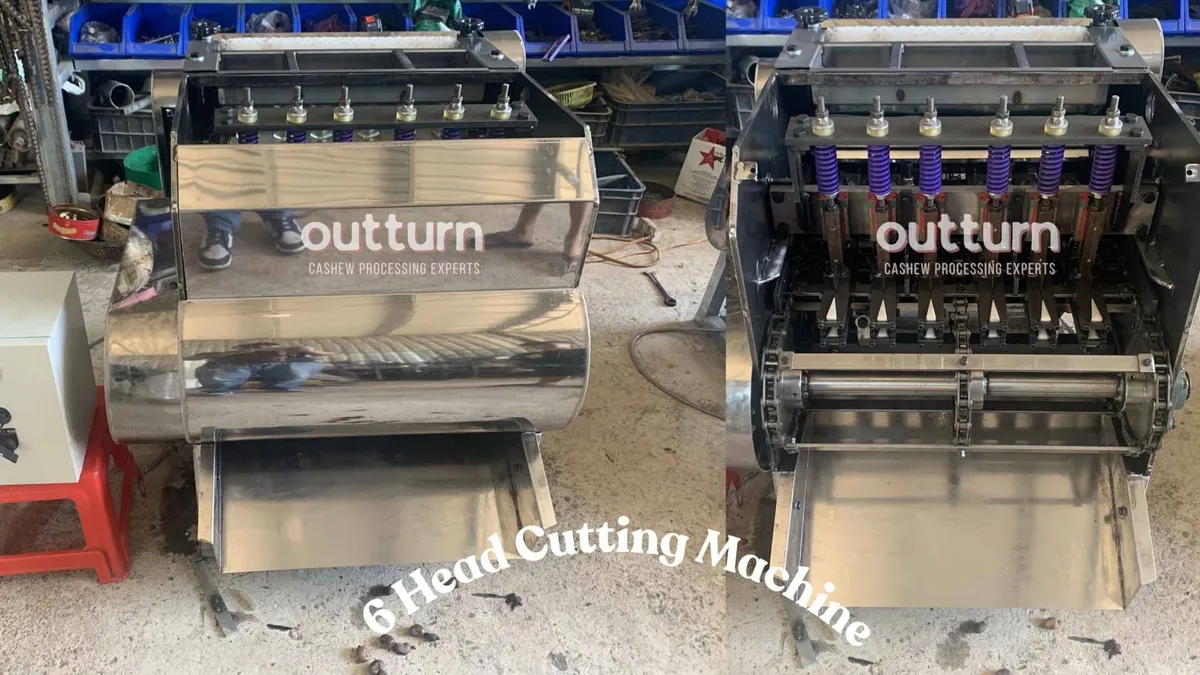
| 6-Head | 6 | 130–160 | 1 HP / 0.75 kW, 3-phase | ~85–88% | 1–2 | Small-medium: 1–2 tonnes RCN/day |
| 8-Head | 8 | 180–220 | 1 HP / 0.75 kW, 3-phase | ~85–88% | 2 | Medium plant: 1.5–3 tonnes RCN/day |
| 10-Head | 10 | 280–320 | 1 HP / 0.75 kW, 3-phase | ~85–88% | 2 | Medium-large: 3–4 tonnes RCN/day per unit |
| 12-Head | 12 | 340–400 | 1 HP / 0.75 kW, 3-phase | ~85–88% | 2 | High-capacity: 4–5 tonnes RCN/day per unit |
Throughput drops 10–20% on harder-shell origins (India, Guinea-Bissau) and on high-moisture or poorly steamed batches. These figures are not rated maximums — they are achievable mid-range numbers from plants running at normal commercial conditions.
Sizing the Machine to Your Plant
Working Backwards from Kernel Output
The starting point is your kernel target, not the machine spec. A cashew plant produces roughly 22–24 kg of kernel per 100 kg of RCN (the standard KOR is approximately 48–50 lb per 80 kg bag, which works out to ~25%). With that conversion, the required RCN throughput per hour follows directly from your daily kernel target and your shift length.
A plant targeting 500 kg of kernel per day on an 8-hour shift needs to process approximately 2,175 kg of RCN per day, or 272 kg/hr. One 8-head machine at 200 kg/hr gets close but will not quite reach that consistently. Two 6-head machines at 145 kg/hr each will cover it with room to spare. One 10-head machine at 300 kg/hr gives comfortable headroom.
| Target Kernel (per day) | RCN Required (per day) | RCN/hr on 8-hr shift | Recommended Configuration |
| 50–100 kg | ~220–435 kg | 28–55 kg/hr | 1× 2-Head or 1× 4-Head |
| 100–250 kg | ~435–1,085 kg | 55–135 kg/hr | 1× 4-Head or 1× 6-Head |
| 250–500 kg | ~1,085–2,175 kg | 135–270 kg/hr | 1× 8-Head or 2× 6-Head |
| 500–750 kg | ~2,175–3,260 kg | 270–410 kg/hr | 1× 10-Head or 2× 8-Head |
| 750–1,000 kg | ~3,260–4,350 kg | 410–545 kg/hr | 1× 12-Head or 2× 10-Head |
| 1,000+ kg | 4,350+ kg | 545+ kg/hr | Multiple 10-Head or 12-Head units |
KOR assumed at 25%. Guinea-Bissau or premium Côte d’Ivoire lots can reach 25–27%; lower-quality or high-moisture batches from some origins may fall to 20–21%. Adjust your sizing calculation accordingly — a 2% KOR difference on a 2-tonne/day plant changes your RCN requirement by nearly 200 kg/day.
One Large Machine or Two Smaller Ones
This comes up on most medium-scale enquiries and there is no universal answer — it depends on what failure looks like for your operation.
One machine is simpler: one blade set to stock, one maintenance schedule, one operator pair, one point of synchronization with the autoclave batch. A single 10-head or 12-head machine is also cheaper than two 6-head machines producing equivalent throughput.
Two machines give you continuity when one goes down. Blade replacement on one head takes 45–90 minutes. During that time the second machine keeps running. For processors with back-to-back export commitments, a single-machine line is a risk — one unexpected stop can cascade into a delayed shipment. Plants processing more than 3 tonnes per day almost always run two machines for this reason.
There is also a batch timing consideration. Vietnamese stationary autoclaves produce 800–1,000 kg batches. A 10-head machine at 300 kg/hr processes one batch in roughly 2.5–3 hours — that slots cleanly into a 3-batch-per-shift schedule. Two 6-head machines at 145 kg/hr each take about the same time on the same batch but allow one machine to be serviced while the other handles the next batch.
Power Supply
All OUTTURN cutting machines require three-phase supply. Running them on single-phase with a phase converter is not recommended — if the converter is undersized for the starting surge, motor damage follows. In most commercial or light-industrial zones across West Africa, East Africa, and Southeast Asia, three-phase supply is available. Verify before ordering.
The actual power draw is low: 0.48–0.55 kW under normal load on any OUTTURN model. A complete cutting line — machine, feed conveyor, vibration screen, shell blower — typically draws 2.0–2.5 kW total. A 5 kVA generator is adequate backup for a single line if grid supply is unreliable.
→ EXTERNAL LINK: Three-phase motor supply and sizing requirements → https://www.schneider-electric.com/en/work/campaign/motor-management/ (Technical reference on three-phase motor specifications)
→ INTERNAL LINK: Cashew Processing Plant Cost — power infrastructure and utility setup costs by country → /cashew-processing-plant-cost/
Vietnamese Rotary vs Indian Piston Design
Both traditions produce commercially used machines. The differences are real and relevant to the purchase decision.
| Parameter | Vietnamese Rotary (OUTTURN) | Indian Piston (Konark series) |
| Cutting mechanism | Horizontal rotary — continuous feed | Vertical piston — batch stroke per nut |
| Throughput: 4-head equivalent | 80–100 kg/hr | 110–120 kg/hr (Konark-120) |
| Throughput: 6-head equivalent | 130–160 kg/hr | 150–180 kg/hr (Konark-150+) |
| Whole kernel rate (WKR) | ~85–88% | ~97–98% with carbide blades, correct nut orientation |
| Motor — single unit | 1 HP / 0.75 kW, same across 4–12 head | 0.37–0.746 kW depending on model |
| RCN orientation | Handled by feed geometry | Operator-assisted or mechanical guide required |
| Best suited for | W240–W450, high-throughput, lower labor intensity | W180–W320, precision cutting, harder shell origins |
| Blade type and life | Replacement every 3–6 months typical; standard tooling | Carbide blades — longer life, higher unit cost |
| FOB price | USD 2,000–5,000 depending on head count | Lower entry cost at small scale |
| After-sale support in Africa | On-site installation and training included | Distributor-dependent; varies by country |
The WKR difference is significant and worth being clear about. Indian piston machines achieve 97–98% because the operator controls nut orientation and the blade mechanism can be precisely calibrated for a specific nut size. The tradeoff is throughput — at the 4-head and 6-head scale, the Konark machines are faster per head on per-nut processing time, but OUTTURN’s rotary mechanism at higher head counts (10, 12) pulls ahead on total volume.
For a plant producing W180 or W210 grades — where a whole kernel commands USD 2.00–2.25/kg more than a broken piece and where the grade distribution directly affects contract value — the 97–98% WKR of an Indian-design machine may be commercially worth the lower throughput. For W240, W320, and W450 at medium-to-high volume, the OUTTURN rotary design is the standard choice across West Africa, East Africa, and Vietnam.
At the 10-head and 12-head scale, there is no Indian-design equivalent in wide commercial use. That capacity range belongs to Vietnamese rotary design.
Blade Life and Replacement
Blade life on OUTTURN machines varies with RCN shell hardness. The following table covers the main origins. These are operational ranges based on single-shift (8-hour) usage — extend proportionally for double shifts.
| RCN Origin | Shell Hardness | Typical Blade Life | Early Warning Signs |
| Côte d’Ivoire | Medium | 4–6 months | Whole kernel rate drifting below 84%; more uncut nuts in output |
| Nigeria (mid-season) | Medium | 3–5 months | Check blade condition from month 3 |
| Tanzania (dry season) | Medium-hard | 3–4 months | Monthly check from month 2; throughput drop precedes WKR drop |
| Guinea-Bissau | Medium-high | 3–4 months | Throughput reduction is the first visible sign of wear |
| India (Maharashtra) | Hard | 2–3 months | Highest wear rate of common origins; plan replacement proactively |
| Vietnam (domestic) | Thin-medium | 5–7 months | Softest commercial shells; easiest on blades |
OUTTURN supplies a spare blade set with every machine and holds stock in Binh Phuoc for air freight. Blade replacement does not require specialist tooling. A trained operator replaces a full blade set in 45–90 minutes per head. The machine does not need to leave the plant.
Track blade wear through two numbers logged per shift: whole kernel rate and uncut nut percentage. WKR below 80% — inspect immediately. Uncut percentage above 5% — check blade gap and feed rate before checking the blades themselves, since gap drift is a more common cause than blade failure.
Annual Cost of Ownership
The FOB price (USD 2,000–5,000 depending on model) is the starting number, not the full number. Below is a realistic annual breakdown for an OUTTURN 8-head machine running one 8-hour shift, 250 days per year, in Côte d’Ivoire at the industrial electricity rate of USD 0.105/kWh.
| Cost Item | Annual Estimate (USD) | Notes |
| Machine purchase — amortised over 5 years | ~600–900/yr | USD 3,000–4,500 FOB |
| Freight, import duty, and installation | ~400–700 (one-time) | Country-specific; see country page for duty rate |
| Blade replacements | ~150–300/yr | 2–3 sets per year at mid-range RCN origin |
| Lubrication and consumables | ~80–120/yr | Bearings, oil, minor fasteners |
| Electricity (cutting machine only) | ~180–320/yr | 0.55 kW × 8 hrs × 250 days × $0.105/kWh |
| Operator labor | Site-specific | 2 operators; not included in this table |
| Total (excl. labor) | ~1,010–2,340/yr | Wide range driven by duty and freight variation |
Electricity is not the dominant cost for the cutting machine at this scale — blade replacement is. The electricity figure in the table covers the cutting machine motor only. The full-plant electrical picture, where peeling compressors and drying equipment dominate, is covered separately.
→ INTERNAL LINK: Cashew Processing Plant Cost: Full Breakdown → /cashew-processing-plant-cost/
→ INTERNAL LINK: What Is KOR? Formula, Benchmarks, and How to Improve Your Outturn → /cashew-kor-outturn-formula/
Installation, Training, and Spare Parts
OUTTURN machines ship FOB from Binh Phuoc, Vietnam. On-site installation and operator training are included in the machine price — not charged separately. The installation visit covers assembly, alignment, feed setup, blade adjustment, and training on RCN preparation requirements and machine calibration. It typically takes 2–3 days depending on the number of machines and the readiness of the site.
Spare blades and bearings are held in stock in Vietnam and can be air-freighted to most locations within 5–7 business days. Technical support runs via WhatsApp (+84 979 378 602), which allows video diagnosis of most operational issues without a site visit. For problems that cannot be resolved remotely, a follow-up site visit can be arranged.
Common Questions
Can I run an OUTTURN machine on single-phase power?
No. Three-phase supply is required. Single-phase to three-phase converters exist but risk motor damage or warranty voiding if the converter cannot handle starting surge. Resolve the power supply question before ordering — it affects site readiness more than equipment lead time.
Does RCN need to be graded by size before cutting?
For reliable whole kernel rates, yes. Blade gap is set for a specific nut size range. Running mixed sizes — small W450 nuts and large W180 nuts in the same batch — means the gap is wrong for one end of the size distribution. Either the large nuts are not split cleanly, or the small nuts are cut too deep. Most plants process each RCN grade through in separate batches, usually sorted by origin and size grade at intake.
Why does the 10-head machine use the same motor as the 4-head?
The rotary mechanism distributes the cutting load across all heads simultaneously. Adding heads increases the mechanical work done per revolution, which marginally increases the load factor, but not enough to require a larger motor. At the 10-head configuration, the motor runs at roughly 68–72% of rated capacity — still well within continuous duty range. The design is efficient because the rotating assembly does not need to overcome a per-nut impact load the way a piston mechanism does.
How long does shipping take from Vietnam to West Africa?
Sea freight from Ho Chi Minh City to Lagos, Abidjan, Lomé, Cotonou, or Dakar typically runs 25–35 days depending on routing and transshipment points. Air freight is possible for a single machine but the cost is significant relative to the machine price. Lead time from order confirmation to dispatch is 2–4 weeks depending on configuration. Plan the total timeline at 8–12 weeks from order to on-site readiness.
What whole kernel rate can I realistically expect?
85–88% on correctly steamed, properly graded RCN under good operating conditions. Below 80% almost always points to an upstream issue: understeaming, cutting within a few hours of steaming (before the rest period), or high moisture content at the time of cutting. Blade condition is a secondary cause — dulled blades produce more uncut nuts before they significantly increase breakage. If breakage is high but uncut percentage is low, check blade gap alignment rather than blade sharpness.
